 Posted by
 In recent years, travel costs across Central and Eastern Europe have changed significantly. Countries that once offered ultra-low budgets are now seeing higher prices driven by tourism growth, inflation, and rising living costs. In this comparison, we examine key travel cost categories for Poland and compare them with other popular Eastern European destinations — the Czech Republic, Hungary, and Romania — using real price ranges for 2026. This detailed guide helps travelers make informed decisions and plan realistic budgets before booking.
Hotels & Apartments (Affiliate)
Hotels in Poland (Booking.com)
Hotels in Czech Republic (Booking.com)
Hotels in Hungary (Booking.com)
Hotels in Romania (Booking.com)
1. Overview: Cost Landscape in Eastern Europe
Here’s how the region generally stacks up for travel costs in 2026:
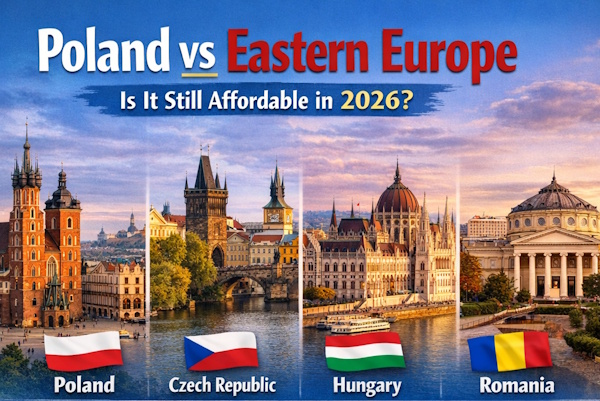
- Most affordable overall: Romania
- Best value combination: Poland and Hungary
- Most expensive: Czech Republic
However, prices vary widely within countries — especially between capitals, major tourist centres, and smaller towns. Cities with heavy tourism can command significantly higher prices than emerging destinations.
2. Accommodation Costs: Hostels, Hotels & Apartments
Accommodation represents the largest share of travel expenses for many visitors. Below are typical nightly price ranges in 2026.
Hostel Dorm Bed (per night)
- Poland: €15–€35
- Czech Republic: €20–€40
- Hungary: €15–€35
- Romania: €10–€25
Budget Double Room (Guesthouse or Budget Hotel)
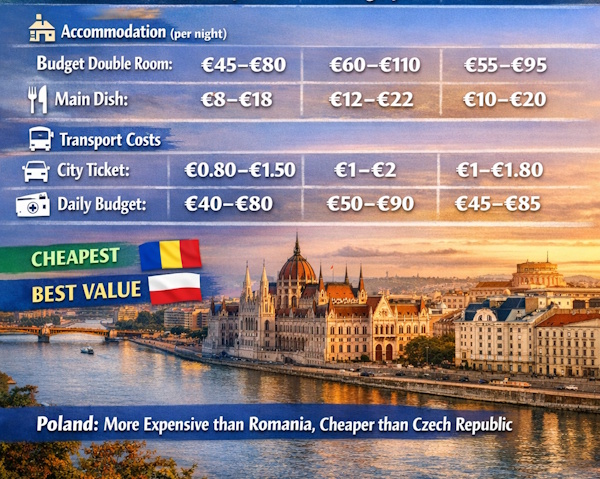
- Poland: €45–€80
- Czech Republic: €60–€110
- Hungary: €55–€95
- Romania: €40–€70
3-Star Hotel (City Centre)
- Poland: €60–€120
- Czech Republic: €80–€150
- Hungary: €70–€140
- Romania: €50–€100
4-Star Hotel (City Centre)
- Poland: €100–€200
- Czech Republic: €120–€220
- Hungary: €110–€200
- Romania: €80–€160
In Prague, prices can rise more steeply than in other capitals, especially in historic districts. Kraków and Warsaw, while increasing, still frequently offer better mid-range values. Romania remains cheapest in both budget and mid-range segments, particularly outside the capital Bucharest.
3. Dining & Food Prices
Food costs often reflect the overall affordability of a destination. Below are typical price ranges for restaurants and local dining.
Main Dish in a Sit-Down Restaurant
- Poland: €8–€18
- Czech Republic: €12–€22
- Hungary: €10–€20
- Romania: €7–€15
Cappuccino or Café Coffee
- Poland: €2.50–€4.50
- Czech Republic: €3–€5
- Hungary: €2.50–€5
- Romania: €2–€4
Beer (0.5L in a Restaurant)
- Poland: €3–€5
- Czech Republic: €2–€4
- Hungary: €2.50–€4
- Romania: €2–€3.50
Three-Course Dinner for Two
- Poland: €35–€70
- Czech Republic: €50–€90
- Hungary: €45–€80
- Romania: €30–€60
Romania tends to offer the lowest meals overall, while Prague’s restaurant prices reflect heavy tourism demand. Poland and Hungary are comparable for mid-range dining, often offering better value outside major tourist zones.
4. Grocery & Supermarket Prices
| Product | Poland | Czech Rep. | Hungary | Romania |
|---|---|---|---|---|
| Water 1.5L | €0.50–€0.90 | €0.50–€1.00 | €0.50–€0.90 | €0.40–€0.80 |
| Bread | €0.80–€1.50 | €1.00–€2.00 | €1.00–€1.80 | €0.60–€1.20 |
| Milk (1L) | €0.80–€1.20 | €0.90–€1.30 | €0.90–€1.30 | €0.70–€1.00 |
Supermarket prices are closer across countries than restaurant prices. Romania still tends to be the cheapest, but differences are smaller than for dining out.
5. Public Transportation & Local Travel
City Transport Ticket (Single Trip)
- Poland: €0.80–€1.50
- Czech Republic: €1–€2
- Hungary: €1–€1.80
- Romania: €0.60–€1.20
Taxi (Short Ride ~5 km)
- Poland: €5–€12
- Czech Republic: €8–€18
- Hungary: €7–€15
- Romania: €4–€10
Monthly Transport Pass
- Poland: €25–€45
- Czech Republic: €30–€60
- Hungary: €25–€55
- Romania: €20–€40
Transport costs in Prague are higher than in Warsaw or Kraków. Romania generally has the lowest everyday transport costs.
6. Intercity Travel: Trains & Buses
Distances between major cities are similar, but prices and travel experience vary.
- Poland (300 km train): €15–€40
- Czech Republic (300 km train): €20–€50
- Hungary (300 km train): €20–€45
- Romania (300 km train): €10–€30
Romania offers the cheapest long-distance options, though travel times can be longer and amenities vary. Train travel in the Czech Republic tends to be reliable but more expensive.
Compare flight prices | Compare rental cars
7. Fuel Prices (Per Liter)
- Poland: €1.40–€1.80
- Czech Republic: €1.50–€1.90
- Hungary: €1.50–€1.90
- Romania: €1.40–€1.80
Fuel prices are broadly similar, though local taxation and global oil price shifts can cause weekly changes.
8. Typical Daily Travel Budgets (2026)
Backpacker / Budget Style
- Poland: €40–€80
- Czech Republic: €50–€90
- Hungary: €45–€85
- Romania: €30–€70
Mid-Range Traveler
- Poland: €90–€180
- Czech Republic: €110–€200
- Hungary: €100–€190
- Romania: €80–€150
Comfort / Premium Traveler
- Poland: €200–€400+
- Czech Republic: €250–€450+
- Hungary: €220–€400+
- Romania: €150–€300+
Poland provides strong mid-range value. Romania remains the most budget-friendly for long stays, while the Czech Republic leads in higher peak pricing.
9. Tourism Pressure, Seasonal Effects & Value
Tourist numbers influence pricing and availability. Prague consistently sees high visitor density relative to its size, pushing up accommodation and restaurant rates in the centre. Kraków and Warsaw also attract strong tourism, especially in summer. Emerging Romanian destinations can offer lower prices but sometimes limited service capacity.
Book Tours & Activities (Affiliate)
10. Final Verdict: Where Does Poland Stand?
Poland remains a competitive choice in Central and Eastern Europe for travelers seeking good value without compromising travel comfort. While Romania is generally cheaper across most categories, Poland offers a balance of:
- Modern infrastructure and tourism services
- Relatively affordable accommodation and restaurant prices
- Good transport networks
- Moderate daily budgets suitable for a wide range of travelers
The Czech Republic, especially Prague, is typically the most expensive option in the region, while Hungary’s costs largely track with Poland. Travelers focused on lowest budgets may prefer Romania, but Poland remains an excellent option for mid-range travel planning in 2026.