 Posted by
 When you plan a trip, you often need more than “Poland is affordable” or “Poland is safe.” For travel planning, concrete numbers are much more useful: how big the country is, how many tourists visit each year, what typical daily costs look like, what the exchange rate is, and how Poland compares to the United States in areas that matter to travelers (safety, distances, prices, infrastructure).
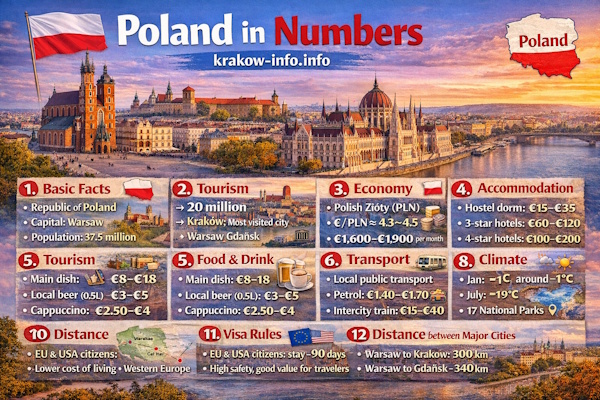
This article summarizes Poland “in numbers” for tourists and adds comparisons with the USA where it makes sense. The goal is practical planning: budgeting, choosing the best travel season, and understanding what to expect on the ground.
Tours & tickets in Poland (affiliate)
If you want to pre-book popular activities (especially in Kraków and around Auschwitz, Wieliczka, Zakopane), check current availability and prices here:
1) Poland: Basic country numbers (quick overview)
Population and size
- Population (Poland): roughly 37–38 million people (depending on the estimate and reference date).
- Population (USA): about 342 million (official estimate for mid-2025).
- Area (Poland): 312,696 km².
- Area (USA): about 9.8 million km² (for scale: the USA is more than 30x larger by area).
What this means for travelers: Poland feels compact compared to the USA. You can cover major highlights (Warsaw, Kraków, Gdańsk, Wrocław, Zakopane) within one trip without spending days on internal flights.
Coastline, mountains, and nature
- Coastline (Poland): around 770 km along the Baltic Sea.
- Highest peak (Poland): Rysy, about 2,500 m.
- National parks (Poland): 23.
Poland’s “range” is a major tourist advantage: Baltic beaches in the north, lake districts in the northeast, and mountain landscapes in the south (Tatra Mountains and surroundings).
2) Currency & exchange rate (with a clear travel takeaway)
Polish currency basics
- Currency in Poland: Polish złoty (PLN).
- Currency in the USA: US dollar (USD).
EUR to PLN reference rate (planning number)
For most European travelers, the key number is the EUR/PLN exchange rate. On March 2, 2026, the ECB reference rate was 1 EUR = 4.244 PLN. That means:
- 10 PLN ≈ 2.35 EUR
- 50 PLN ≈ 11.80 EUR
- 100 PLN ≈ 23.60 EUR
Practical tip: use PLN for a realistic daily budget. Many tourist prices in Poland are still listed in złoty, and comparing in PLN helps avoid constant mental conversion.
Cards vs cash in Poland
Card payments are widely accepted in Poland (especially in cities). Cash is still useful for small purchases, markets, and some local services. In the USA, card payments are also the norm, but the travel difference is that tipping culture in the USA changes the final price more significantly (see the tipping section below).
Compare flights (Kayak) | Compare rental cars (Kayak)
3) Tourism numbers: how many people visit Poland?
International arrivals
Poland has recently reported record foreign visitor numbers. A widely cited estimate for 2025 is over 20 million international arrivals, up from around 19.4 million in 2024.
That matters for tourists because it influences:
- Accommodation prices in peak season
- Lines at top attractions (especially Kraków area sites)
- Availability of guided tours and tickets
Tourists using accommodation in Poland
Another useful tourism indicator is the number of people staying in formal accommodation (hotels, guesthouses, rentals). For 2025, Poland reported about 58.9 million tourists staying in accommodation facilities (this includes domestic and foreign tourism, not only international arrivals).
Hotels & apartments in Poland (affiliate)
For realistic price checks by city and travel dates (Kraków, Warsaw, Gdańsk, Wrocław, Zakopane):
4) Poland vs USA: travel distances (numbers you can use)
Typical distances inside Poland
- Warsaw – Kraków: ~300 km
- Warsaw – Gdańsk: ~340 km
- Kraków – Zakopane: ~110 km
- Gdańsk – Szczecin: ~350 km
Travel takeaway: many city-to-city routes in Poland are “Germany-sized” day trips by train or car. In the USA, city-to-city travel often becomes a flight decision much earlier due to scale.
Scale comparison: why it matters
In the USA, a “medium” travel day can mean 500–800 km by car without crossing half the country. In Poland, 500–800 km often takes you across most of the country. This is a key reason Poland works well for 7–14 day itineraries with multiple stops.
5) Transportation infrastructure (Poland in numbers + comparison)
Airports and passengers
Poland has a network of international and regional airports. The main hub is Warsaw Chopin Airport, and it has grown strongly in recent years.
- Warsaw Chopin Airport passengers (2025): about 24.1 million
- Warsaw Chopin Airport passengers (2024): about 21.3 million
For travelers, that growth typically means more routes, better low-cost options, and more competitive pricing. It can also mean higher demand in summer, so flight prices can rise quickly close to departure.
Rail: an important planning number
- Poland rail network length: about 19,000 km of track
Rail is a serious option for tourists. Long-distance routes connect major cities, and regional rail can be practical for many areas (though service quality and frequency vary by region). In the USA, rail travel is usually less central for tourist itineraries (with exceptions like the Northeast Corridor).
6) Prices in Poland (with USA comparisons where useful)
Price comparisons are tricky because cities differ. Warsaw and Kraków are more expensive than smaller towns, and tourist hotspots have higher prices than local neighborhoods. The numbers below are “typical travel ranges” to help with realistic planning.
Quick planning assumption: Poland is usually cheaper than the USA
For most tourist categories (food, local transport, mid-range hotels), Poland tends to be significantly cheaper than large US cities. However, Poland is not “ultra cheap” anymore in the most popular areas during summer, and top hotels can be priced similarly to Western Europe.
Typical travel prices: Poland vs USA (overview table)
| Category | Poland (typical range) | USA (typical range) | Travel note |
|---|---|---|---|
| Hostel bed | €15–€35 | $35–$70+ | US hostel pricing depends heavily on city; major cities can be far higher. |
| 3-star hotel (double) | €60–€120 | $120–$220+ | In the USA, taxes and fees can increase the final price. |
| 4-star hotel (double) | €100–€200 | $180–$350+ | Poland can offer strong value in 4-star city hotels outside peak dates. |
| Restaurant main dish | €8–€18 | $15–$30+ | US totals may rise with tax + tip (often 15–20%). |
| Coffee / cappuccino | €2.50–€4.50 | $3.50–$6.50 | Specialty coffee in tourist zones is priced similarly worldwide. |
| Local public transport ticket | €0.80–€1.50 | $2–$3.50 | US public transport coverage varies strongly by city. |
| Taxi / ride fare (short trip) | €5–€12 | $12–$30+ | Surge pricing in the USA can be significant. |
| Gasoline (1 liter) | €1.40–€1.80 | USA uses gallons | Fuel costs per km are often higher in Europe than in the USA. |
Simple daily budgets (planning ranges)
- Budget traveler in Poland: €40–€80/day (hostel, public transport, simple meals)
- Mid-range traveler in Poland: €90–€180/day (3–4 star hotel, restaurants, tours)
- Mid-range traveler in many US cities: often $150–$300/day (hotel costs drive this)
For affiliate monetization, numbers work well if you place tour and hotel links close to budgeting sections: readers who compare costs often book immediately once they see Poland’s value.
7) Safety numbers: Poland vs USA (what tourists should know)
Safety is one of the most searched travel topics. A practical approach is to focus on a few comparable numbers and then add a realistic traveler interpretation.
Homicide rate (internationally comparable)
- Poland homicide rate (2023): 0.802 per 100,000
- USA homicide rate (2023): 5.763 per 100,000
Travel takeaway: Poland is generally considered very safe for tourists, with low rates of violent crime at a national level. In the USA, safety can vary strongly by city and neighborhood; tourists often focus on local conditions rather than national averages.
Road safety (traffic fatalities)
- Poland traffic fatalities (2024): 1,896
- USA traffic fatalities (2024): 39,345 (preliminary figure reported by NHTSA via Reuters)
Travel takeaway: if you plan a road trip, local driving style, road quality, and speed enforcement can matter more than crime risk. In Poland, major roads have improved a lot, but rural roads and winter conditions can still require attention.
8) Climate numbers (best travel time in data terms)
Poland has a temperate climate with clear seasons. The “best time” depends on what you want: city trips, beaches, hiking, or Christmas markets.
Typical temperatures (Warsaw-style reference)
- January: around -1°C (often colder at night)
- April: around 9°C
- July: around 19°C
- October: around 9°C
Baltic Sea water temperature (summer)
- Summer peak: often around 18–22°C
Compared to many US travel regions, Poland’s summer is usually milder than hot/humid parts of the USA. This is one reason Poland is sometimes promoted as a “cool summer” alternative to the Mediterranean during heatwaves.
9) Rules and practical numbers tourists ask about
Emergency numbers
- Emergency in Poland (and EU): 112
- Emergency in the USA: 911
Alcohol limits (driving)
- Poland legal BAC limit: 0.2‰ (very strict)
- USA legal BAC limit: commonly 0.08% (varies by state)
Travel takeaway: if you rent a car in Poland, treat the alcohol limit as “effectively zero” for safe planning. Even one drink can put you at risk of crossing the limit.
Compare rental car prices (Kayak)
10) Poland’s “capacity” for tourists: why numbers matter in peak season
Tourism growth is good for services, but it creates peak-season pressure. Poland’s top tourist regions (Kraków, Zakopane, Gdańsk) can be crowded in July and August. If you travel then, the most relevant numbers are not only “how many tourists visit Poland,” but how early you should book:
- Summer city breaks: book hotels 4–10 weeks ahead for best value
- Popular day tours: book at least 3–14 days ahead (earlier for holidays)
- Holiday weekends: expect higher rates and lower availability
This is also where affiliate links convert well: readers who realize peak demand often click through to check live availability.
Check live tour availability (affiliate)
For high-demand sights (Kraków area, Auschwitz, Wieliczka), booking ahead can save time and reduce stress:
11) FAQ: Poland in numbers (tourist questions)
Is Poland expensive compared to the USA?
In most travel categories, Poland is cheaper than the USA, especially compared to large US cities. Hotels and restaurant meals tend to cost less, and local public transport is usually significantly cheaper. The biggest “USA cost factor” is often the combination of hotel prices plus tax and tipping.
How big is Poland compared to the USA?
Poland’s area is 312,696 km², while the USA is roughly 9.8 million km². In practical travel terms: Poland is compact. You can combine several major regions in one trip without internal flights.
What is a realistic EUR to PLN reference number for planning?
A practical reference is the ECB EUR/PLN rate. On March 2, 2026, it was 1 EUR = 4.244 PLN. For travelers, that makes 100 PLN roughly 23–24 EUR (depending on the daily rate).
How safe is Poland compared to the USA?
Using the intentional homicide rate as an internationally comparable metric, Poland’s rate (2023) is far lower than the USA’s. For tourists, that usually translates into a low risk of violent crime in typical travel areas, while normal big-city precautions still apply (pickpocketing in crowded places, basic nightlife awareness).
How many tourists visit Poland per year?
Recent reporting suggests over 20 million international arrivals in 2025, with tourism still growing. In addition, many tens of millions of tourists (domestic and international combined) use accommodation facilities in Poland each year.
Is it easy to travel around Poland without a car?
Yes, for many itineraries. Poland’s rail network is around 19,000 km and major cities have frequent connections. A car becomes more useful for rural areas, small villages, and flexible mountain or lake region routes.
12) Sources (for the main numbers)
- Population (USA): US Census Bureau press release (population estimate for mid-2025).
- Population (Poland): UN-based estimates and recent Polish statistics reporting on population levels.
- Area, coastline, national parks: geography references for Poland.
- EUR/PLN exchange rate: European Central Bank reference rate (daily).
- Tourism arrivals: Polish Tourism Organisation estimates reported in Polish media and tourism industry reporting.
- Warsaw Chopin passengers: official airport “facts and figures.”
- Homicide rate: UNODC-vetted international comparison table (latest available year listed).
- Road fatalities (Poland): Polish road safety reporting based on police statistics; (USA) NHTSA preliminary data reported by Reuters.